Black White Cartoon Food Characters: A Design Evaluation
In the realm of digital illustration and graphic design, monochromatic assets offer a distinct aesthetic utility that colored alternatives often cannot match. Black White Cartoon Food Characters represent a specific category of vector art designed to provide high-contrast, scalable imagery for various commercial and creative applications. These assets typically feature stylized representations of popular food items rendered in a simplified, two-tone palette. When evaluating such resources, it is essential to understand not just what they are, but how they function within a broader design strategy.
Defining the Asset Class
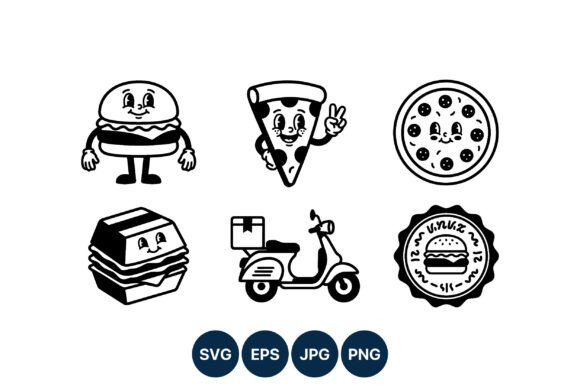
Black White Cartoon Food Characters refer to a collection of vector illustrations where food items are depicted using only black and white tones. Unlike photographic realism or full-color rendering, this style relies on line work, solid fills, and negative space to define form and expression. A typical set might include a hamburger with a smiling face, a slice of pizza, a whole pie, a stacked sandwich, and related service elements like a delivery scooter carrying a package. Often, these collections also include decorative elements, such as a burger emblem framed by an ornamental border.
The technical foundation of these assets is crucial to their value. They are generally provided as vector files, specifically in SVG (Scalable Vector Graphics) and EPS (Encapsulated PostScript) formats, alongside raster versions like PNG and JPG. The vector nature ensures that the artwork remains crisp and sharp at any resolution, from a small mobile app icon to a large billboard. The high-contrast nature of the black and white scheme eliminates color distractions, forcing the viewer to focus on the shape, character, and composition of the subject matter.
Reasons for Interest and Adoption
Designers and content creators may seek out Black White Cartoon Food Characters for several strategic reasons. The primary driver is often versatility. In a world where brand guidelines frequently dictate strict color palettes, having a neutral base allows for easy recoloring or integration into existing schemes without clashing. Furthermore, the cartoon style adds a layer of approachability and personality to food branding, which can be particularly effective for fast-food chains, delivery services, or casual dining establishments aiming to appear friendly and accessible.
Another significant factor is the speed of production. High-quality custom illustration is time-consuming and expensive. Pre-made vector sets allow designers to incorporate professional-grade imagery into projects immediately. The inclusion of specific elements like a delivery scooter with a package addresses modern logistics themes, making these assets relevant for companies emphasizing speed and service. Additionally, the availability of multiple file formats in a single ZIP download streamlines the workflow, ensuring compatibility across different software environments and output mediums.
Benefits and Tradeoffs
Adopting this style offers clear benefits, primarily regarding scalability and print consistency. Because the artwork is 100% vector-based, there is no pixelation when scaling up. This is vital for print materials such as menus, packaging, and signage where clarity is non-negotiable. The high-contrast black and white format also translates exceptionally well to single-color printing processes, such as screen printing on t-shirts or embossing on packaging, where multi-color registration can be problematic or costly.
However, there are tradeoffs to consider. The most obvious limitation is the lack of inherent color. While this offers neutrality, it can also result in a flat appearance if not carefully integrated into a design that provides context. Without the psychological triggers of color—such as red stimulating appetite or green suggesting freshness—the imagery relies entirely on its character design to convey emotion. Additionally, the cartoon style may not align with brands positioning themselves as gourmet, artisanal, or luxury. In those contexts, the playful nature of a smiling pizza slice might undermine a message of sophistication.
Strategic Considerations for Selection
When deciding whether Black White Cartoon Food Characters fit a project, several factors must be weighed. First, evaluate the target audience. If the demographic includes children or families, the anthropomorphic nature of the characters is likely to resonate well. For a corporate B2B audience, the same imagery might feel too juvenile. Second, consider the medium of deployment. These assets excel in situations requiring bold lines and clear silhouettes, such as icons, logos, and social media graphics where attention spans are short.
It is also important to assess the licensing and customization needs. While the download typically includes a comprehensive set of files, designers should verify if the license permits modification. Can the black fill be changed to a brand's signature blue? Can the decorative border be removed or resized? Understanding these permissions prevents legal complications later. Finally, consider the visual weight of the design. High-contrast black and white images can dominate a layout; they require careful balancing with whitespace and typography to avoid overwhelming the viewer.
Situations Where This Style Excels
This specific asset class is a strong fit for several scenarios. It is ideal for brand identity systems that require a consistent, recognizable mascot or iconography across various touchpoints. For example, a food delivery startup might use the scooter and package imagery to create a cohesive visual language for their app interface and marketing materials. It is also highly effective for educational materials, such as children's books about nutrition or restaurant training manuals, where simplicity aids comprehension.
Furthermore, these characters work well in retail environments where visibility is key. Large-scale wall decals or menu board graphics benefit from the bold outlines and high contrast, ensuring legibility from a distance. The decorative borders included in many sets, such as the burger emblem mentioned earlier, are particularly useful for framing text on certificates, awards, or promotional flyers, adding a touch of whimsy without introducing complex color management issues.
When to Consider Alternatives
Despite their utility, Black White Cartoon Food Characters are not a universal solution. Alternatives should be considered when the project demands photorealism. If the goal is to showcase the texture of melted cheese or the freshness of ingredients, a high-resolution photograph or a detailed 3D render will communicate quality more effectively than a flat vector illustration. Similarly, if the brand identity is rooted in minimalism or abstract concepts, the literal representation of a cartoon burger might be too heavy-handed.
Another scenario where alternatives are preferable is when targeting a high-end market. Fine dining establishments often rely on subtle, elegant visuals to convey exclusivity. The cheerful, exaggerated expressions found in cartoon food characters can clash with a sophisticated atmosphere. In these cases, a more subdued, line-art style without anthropomorphism, or a muted watercolor aesthetic, might better serve the brand's narrative. Additionally, if the project requires dynamic lighting effects or complex gradients that cannot be simulated with simple black and white fills, other illustration styles would be more appropriate.
Practical Decision-Making Insights
To determine if this resource aligns with your goals, conduct a quick audit of your current design constraints. Ask yourself if you need an image that scales infinitely without losing quality; if yes, the vector format is a major advantage. Next, review your brand's emotional tone. Does "happy" and "fast" accurately describe the experience you want to convey? If so, the cartoon style supports that message. Finally, check your technical requirements. Ensure your team has access to software capable of editing SVG and EPS files if customization is anticipated.
By weighing the flexibility of the vector format against the stylistic limitations of the black and white cartoon aesthetic, designers can make informed choices. Black White Cartoon Food Characters offer a robust toolkit for specific design challenges, providing clarity, scalability, and character. However, their success depends on matching their inherent traits with the specific needs of the project, ensuring that the final output resonates authentically with the intended audience.